
期刊信息
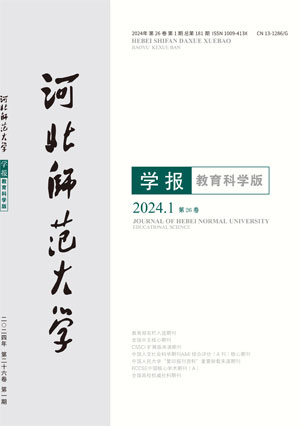
- 刊名: 河北师范大学学报(教育科学版)Journal of Hebei Normal University (Educational Science Edition)
- 主办: 河北师范大学
- ISSN: 1009-413X
- CN: 13-1286/G
- 教育部名栏入选期刊
- 全国中文核心期刊
- CSSCI扩展版来源期刊
- AMI综合评价(A刊)核心期刊
- RCCSE中国核心学术期刊
- 全国高校特色栏目社科学报
- 中国人民大学“复印报刊资料”重要转载来源期刊
- 全国高校权威社科期刊
关于空间和教育空间的再认识:哲学外延与社会学内涵
-
作者单位:(1.浙江省现代职业教育研究中心,浙江 金华 321016;2.教育部职业教育发展中心,北京 100029) -
起止页码:1 - 10页 -
DOI:10.13763/j.cnki.jhebnu.ese.2025.04.001
Reconceptualizing Space and Educational Space: Philosophical Extensions and Sociological Connotations
摘要/Abstract
对人类赖以生存的空间的研究,虽已久之却热度不减。人类正是通过自身在空间的实践活动存在、延续和发展的。当今时代,空间不再像过去那样被理解为一种需要填充和被填充的“容器”,而是被解读为一种人类自我创造的环境,即生活世界的框架,被视为一 种社会的、关系的产物,从而进入了哲学、社会学和教育学的语境。教育作为一种基于人的社会发展需要的活动,则始终在与他人和他者的空间交流中存在,隐含着人与世界,亦即人与时空的关系。将空间研究成果包括对空间的认知及体验迁移至教育领域,使之成为教 育过程和学习过程的推动力,需要基于空间概念的外延对空间本质的哲学反思以及社会空间的内涵予以阐释。从哲学的角度来看,空间源于物理场所而高于物理场所,可理解为,场所是人的生理所感,空间是人的心理所感。从社会学的角度来看,空间是一种关系性存在 ,它勾勒出不断运动着的人与物体之间的关系。作为社会空间特殊形式的教育空间,是教育过程在社会空间维度的映射。教育空间的概念可以从两个维度理解:保持纯真教育目的及其本质因而显现自身固有特性的教育场所;与特定社会环境相互交织的具体的学习场所。 学校学习场所涉及的教育实体空间的建构,既要遵循建筑学的要求和标准,也要遵循教育学的规律和标准。传统的功能固化的空间概念已无法满足数字时代的要求,因此,教育空间应彰显适应性,灵活构建。近年来,教育空间的构建和空间秩序建立出现实体空间“边界 ”逐渐消解的趋势,新时代的广义的教育空间产生。全纳化的教育空间、数字化的教育空间和跨域化的教育空间的互联互通将造就新的混合式教育空间形态。
Research on space, the fundamental dimension of human existence, remains a vibrant scholarly pursuit. Humanity perpetuates and evolves through spatial praxis. Contemporary scholarship transcends the traditional conception of space as a mere container to be filled, instead interpreting it as a human-constructed environment—the framework of the lifeworld—and a socially produced relational construct. This paradigm shift has integrated spatial discourse into philosophical, sociological, and pedagogical contexts. Education, as a socially necessitated human activity, inherently exists through spatial interactions between individuals and their environment, embodying relationships between humans and the world (spatio-temporal reality). Translating spatial research—including cognitive and experiential understandings of space—into educational domains to catalyze pedagogical and learning processes requires systematic analysis: first, examining conceptual extensions of space; subsequently, engaging in philosophical reflections on its ontology and interpreting sociological connotations of social space. Philosophically, space originates from yet transcends physical place: places manifest through sensory perception, while spaces emerge through psychological cognition. Sociologically, space constitutes a relational ontology, mapping dynamic interconnections between people and objects. Educational space, a specialized social space, reflects educational processes within this spatial dimension. Its conceptualization encompasses two dimensions: educational places preserving pedagogical purpose and inherent attributes, and physical learning spaces interwoven with specific societal contexts. Constructing institutional learning environments necessitates adherence to both architectural principles and pedagogical standards. Traditional rigid spatial paradigms prove inadequate for the digital era. Consequently, educational spaces must demonstrate adaptability and be flexibly constructed. Recent trends reveal a gradual dissolution of physical boundaries in the configuration of educational environments and the establishment of spatial order. The interconnectedness of inclusive, digital, and cross-domain educational spaces will give rise to a new paradigm of hybrid educational spatial formations for the contemporary age.
关键词
参考文献 48
- [ 1 ] Herbert Hörz.Philosophische Überlegungen zu Raum und Zeit[A].A.P.Frech.Albert Einstein Wirkung und Nachwirkung[C].Wiesbaden:Verlag Vieweg,1985.
- [ 2 ] 李俊文.马克思主义哲学中国化的社会时空问题研究[J].哲学动态,2011(12):18-23.
- [ 3 ] Johannes Bilstein.Landschaft und Bildung[EB/OL].(2024/2023)[2024-04-02].https://kubi-online.de/artikel/landschaft-bildung.
- [ 4 ] Kristin Westphal.Raum:eine Zentrale Bildungskategorie[A].Constanze Berndt,Claudia Kalisch,Anja Krüger.Räume bilden-pädagogische Perspektiven auf den Raum[C].Bad Heilbrunn:Verlag Julius Klinkhardt,2016.
- [ 5 ] 董慧.马克思的空间概念[N].光明日报,2024-05-13.
- [ 6 ] Rolf Arnold,Ekkehard Nuissl,Josef Schrader.Wörterbuch Erwachsenen-und Weiterbildung(3.vollst.überarb.Aufl.)[K].Bad Heilbrunn:Verlag Julius Klinkhardt,2023.
- [ 7 ] 张桂权.笛卡尔的空间观念及其现代意义[J].四川师范大学学报(社会科学版),2014,41(3):28-32.
- [ 8 ] 李志民.空间是什么?[EB/OL].(2023-10-10)[2025-06-12]. https://hr.edu.cn/xueshu/202310/t20231010_2511451.shtml.
- [ 9 ] 边馥苓,王金鑫.现实空间、思维空间、虚拟空间——关于人类生存空间的哲学思考[J].武汉大学学报(信息科学版),2003(1):4-8.
- [ 10 ] 吕万鹏.基于信息的三个空间理论述要[J].今日科苑,2008(10):206.
- [ 11 ] Henri Lefebvre.The Production of Space[M].Donald Nicholson-Smith,trans.Oxford:Basil Blackwell,1991.
- [ 12 ] Günzel,Stephan;„PHÄNOMENOLOGIE DER RÄUMLICHK EIT“[EB/OL].(2007-03-02)[2024-09-13].https://www.european-spaces.eu/1-archiv/guenzel-stephan-phaenomenologie-der-raeumlichkeit.
- [ 13 ] Charis Lengen.Places:Orte mit Bedeutung[A].Ulrich Gebhard,Thomas Kistemann.Landschaft,Identität und Gesundheit:Zum Konzept der Therapeutischen Landschaften[C].Wiesbaden:Springer VS,2016.
- [ 14 ] Caroline Thon. Was ist “Raum”? Theorien des Raums erläutert am Beispiel des Bildungsraum der Bibliothek[EB/OL].(2017-08-29)[2024-04-02].https://www.grin.com/document/373747.
- [ 15 ] Peter Faulstich.Raum und lernende Subjekte.Konflikte um Lebens-und Lernräume als Impulse für Lernen[A].Christian Bernhard,Katrin Kraus,Silke Schreiber-Barsch,Richard Stang.Erwachsenenbildung und Raum:Theoretische Perspektiven-professionelles Handeln-Rahmungen des Lernens[C].Bielefeld:W.Bertelsmann Verlag GmbH & Co.KG,2015.
- [ 16 ] Constanze Berndt,Claudia Kalisch,Anja Krüger.Einführung[A].Constanze Berndt,Claudia Kalisch,Anja Krüger.Räume bilden-pädagogische Perspektiven auf den Raum[C].Bad Heilbrunn: Verlag Julius Klinkhardt,2016.
- [ 17 ] Olaf Kühne,Karsten Berr.Raumverständnisse und Theorien zu Räumen[EB/OL].(2021-06-03)[2024-04-02].https://link.springer.com/chapter/10.1007/978-3-658-33265-5_6.
- [ 18 ] Johannes Bilstein.Vom Inneren der Seele bis an das Ende der Welt.Raum als pädagogische Kategorie[A].Edith Glaser,Hans-Christoph Koller,Werner Thole,Salome Krumme.Räume für Bildung-Räume der Bildung.Beiträge zum 25.Kongress der Deutschen Gesellschaft für Erziehungswissenschaft[C].Opladen,Berlin,Toronto:Verlag Barbara Budrich,2018.
- [ 19 ] Johannes Bilstein.Raumbildung und Bildungsräume[A].Jeanette Böhme. Schularchitektur im interdisziplinären Disk-urs:Territorialisierungskrise und Gestaltungsperspektiven des schulischen Bildungsraums[C].Wiesbaden:VS Verlag für Sozialwissenschaften,2009.
- [ 20 ] Pierre Bourdieu.Social Space and Symbolic Power[J].Sociological Theory,1989,7(1):14-25.
- [ 21 ] Universität Duisburg-Essen.6 Das Modell des sozialen Raums[EB/OL].(2013-01-24)[2024-04-02].https://www.uni-due.de/imperia/md/content/bildungswissenschaften/sowi/barloesius/derraum.pdf.
- [ 22 ] Bundeszentrale für Politische Bildung.Sozialer Raum[DB/OL].[2024-04-02].https://www.bpb.de/themen/deutsche-einheit/lange-wege-der-deutschen-einheit/501243/sozialer-raum.
- [ 23 ] Löw Martina,Sturm,Gabriele.Raumsoziologie[A].F.Kessl,C.Reutlinger,S.Maurer,O.Frey.Handbuch Sozialraum(1.Auflage)[M].Wiesbaden:VS Verlag für Sozialwissenschaften,2005.
- [ 24 ] Beate Krais.Rezension:Martina Löw:Raumsoziologie[J].Zeitschrift für Qualitative Bildungs-,Beratungs- und Sozialforschung,2001,2(2):347-348.
- [ 25 ] 牟娟.简析列斐伏尔空间理论[J].青年文学家,2009(11):166-167.
- [ 26 ] 林叶.城市人类学再思:列斐伏尔空间理论的三元关系、空间视角与当下都市实践[J].江苏社会科学,2018(3):124-135.
- [ 27 ] Katrin Kraus.Aneignung von Lernorten in der Erwachsenenbildung:zur Empirie pädagogischer Räume[J].REPORT-Zeitschrift für Weiterbildungsforschung,2010,33(2):46-55.
- [ 28 ] Fabian Kessl, Christian Reutlinger.Bildungsräume-ein Konzept zur Analyse urbaner Spielräume[A].Fabian Kessl,Christian Reutlinger.Urbane Spielräume:Bildung und Stadtentwicklung[C].Wiesbaden:Springer VS,2013.
- [ 29 ] Bildungsraum ist...die Definition,die Ziele der Bildung[EB/OL].(2018-10-05)[2024-05-12].https://tostpost.com/de/bildung/12493-bildungsraum-ist-die-definition-die-ziele-der-bildung.html.
- [ 30 ] Helmut Bremer,Mark Kleemann-Göhring,Farina Wagner.Sozialraumorientierung und “Bildungsferne”. Aufsuchende Bildungsarbeit und-beratung in der Weiterbildung[A].Christian Bernhard,Katrin Kraus,Silke Schreiber-Barsch,Richard Stang.Erwachsenenbildung und Raum:Theoretische Perspektiven-professionelles Handeln-Rahmungen des Lernens[C].Bielefeld:W.Bertelsmann Verlag GmbH & Co.KG,2015.
- [ 31 ] Katrin Kraus.Bildungsräume[A].Fabian Kessl,Christian Reutlinger.Sozialraum.Sozialraumforschung und Sozialraumarbeit[C].Wiesbaden:Springer VS,2022.
- [ 32 ] Bernd Dewe,Philipp Hoffmann,Daniel Straβ.Aristoteles und Guardini. Bildungsphilosophische Zugänge zu Raum in der Erwachsenenbildung[A].Christian Bernhard,Katrin Kraus,Silke Schreiber-Barsch,Richard Stang.Erwachsenenbildung und Raum:Theoretische Perspektiven-professionelles Handeln-Rahmungen des Lernens[C].Bielefeld:W.Bertelsmann Verlag GmbH & Co.KG,2015.
- [ 33 ] Konjunkturprogramm Schulbau:für die Zukunftsfähigkeit unseres Landes[EB/OL].(2020-06-02)[2024-05-12].https://www.montag-stiftungen.de/Konjunktur-Schulbau.
- [ 34 ] Richard Stang. Lernräume in Bibliotheken.Optionen für eine offene Lerninfrastruktur[A].Christian Bernhard,Katrin Kraus,Silke Schreiber-Barsch,Richard Stang.Erwachsenenbildung und Raum:Theoretische Perspektiven-professionelles Handeln-Rahmungen des Lernens[C].Bielefeld:W.Bertelsmann Verlag GmbH & Co.KG,2015.
- [ 35 ] Jeanette Böhme,Viktoria Flasche.Raumspuren pädagogischer Sinnkonstruktionen im urbanen Wandel[A].Thomas Coelen,Anna Juliane Heinrich,Angela Million.Stadtbaustein Bildung[C].Wiesbaden:Springer VS,2015.
- [ 36 ] Martin Nugel. Sich entwerfen in,mit und durch Raum.Bildungstheoretische Überlegungen zur Architektur der Erwachsenenbildung[A].Christian Bernhard,Katrin Kraus,Silke Schreiber-Barsch,Richard Stang. Erwachsenenbildung und Raum:Theoretische Perspektiven-professionelles Handeln-Rahmungen des Lernens[C].Bielefeld:W.Bertelsmann Verlag GmbH & Co.KG,2015.
- [ 37 ] 宋岭.教育空间中的身体规训及其改造[J].华东师范大学学报(教育科学版),2022,40(12):26-37.
- [ 38 ] T.Reddel Auβerschulische Lernorte:Definition,Beispiele und Leitfaden für Schulen[EB/OL].(2022-03-14)[2025-05-23].https:∥www.forum-verlag.com/fachwissen/bildung-und-erziehung/ausserschulische-lernorte/.
- [ 39 ] UNESCO.Inclusive Education:The Way of the Future[R].2008.
- [ 40 ] 中华人民共和国教育部.中国智慧教育白皮书[R].2025.
- [ 41 ] 世界数字教育联盟正式成立[EB/OL].(2024-01-30)[2024-09-13].http://www.moe.gov.cn/jyb_xwfb/gzdt_gzdt/s5987/202401/t20240130_1113444.html.
- [ 42 ] „Mein Bildungsraum“:Weiterentwicklung der Vernetzungsinfrastruktur von BMBF und SPRIND[EB/OL].(2024-10-14)[2025-05-27].https:∥www.bildung-forschung.digital/digitalezukunft/de/bildung/mein_bildungsraum/mein_bildungsr aum_node.html.
- [ 43 ] Die „Nationale Bildungsplattform“:Der Aufbau eines Digitalen Bildungsraums mit der Digitalen Vernetzungsinfrastruktur Bildung[EB/OL].(2022-11-01)[2025-05-27].https:∥hochschulforumdigitalisierung.de/die-nationale- bildungsplattform-der-aufbau-eines-digitalen-bildungsraums-mit-der-digitalen-vernetzungsinfrastruktur-bildung/.
- [ 44 ] 教育部关于印发《推进共建“一带一路”教育行动》的通知[J].中华人民共和国教育部公报,2016(9):52-56.
- [ 45 ] 教育部:我国已与58个国家和地区签署了学历学位互认协议[EB/OL].(2022-09-20)[2025-06-12]. http:∥www.moe.gov.cn/fbh/live/2022/54849/mtbd/202209/t20 220920_663336.html.
- [ 46 ] SBFI.Leitbild Berufsbildung 2030[R].2018.
- [ 47 ] The European Education Area and the 2030 Strategic Framework for Education and Training[R/OL].(2021-11-22)[2025-06-13].https:∥www.europarl.europa.eu/RegData/etudes/BRIE/2021/690630/EPRS_BRI(2021)690630_EN.pdf.
- [ 48 ] 付强,辛晓玲.空间社会学视域下的学校教育空间生产[J].山东社会科学,2019(4):74-79.